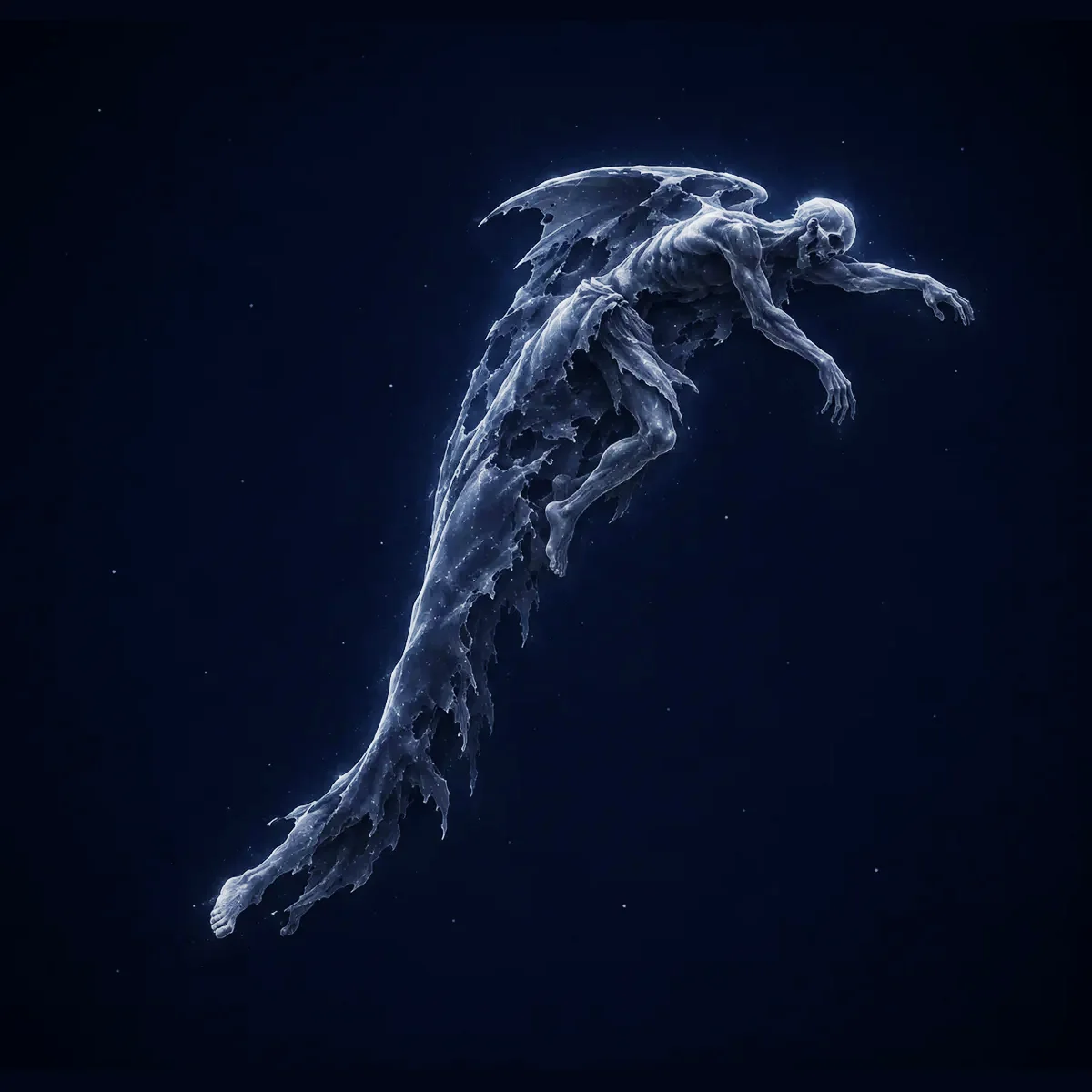
On the pre-Greek Mesopotamian map, next to the Eagle stood the figure of the Dead Man — AD₆ / pagru, “corpse, dead body” — which researchers associate with the region of modern Delphinus. In ancient texts this Dead Man could be understood as the corpse of a hostile demonic being. On our map nearby stand the Eagle — fallen angels — and God’s Arrow: rebellious powers → God’s judgment → the overthrown enemy.
Full interpretation
Verifiable historical, etymological and topographical statements are accompanied by sources. The theological conclusions are the project’s interpretation according to its published methodology.
To understand this small region of the sky, one must go deeper than the Greek image of the Dolphin.[Kunitzsch & Smart][IAU · имена звёзд]
Greek tradition did indeed see a sea creature here and told stories of the Dolphin that saved Arion. But for our study that layer is late and must not determine the primary interpretation.
Far more important is what stood here on the Mesopotamian map.[Hunger & Pingree · MUL.APIN][Rogers · Origins][Вавилонские звёздные каталоги][Stellarium · MUL.APIN]
The Eagle and the Dead Man
In the ancient star list MUL.APIN the following are listed side by side:[Hunger & Pingree · MUL.APIN][Rogers · Origins][Вавилонские звёздные каталоги][Stellarium · MUL.APIN]
Zababa; the Eagle; the Dead Man.
The name of the Dead Man — AD₆ / pagru — means “body,” “corpse,” “dead man.”
The Eagle and the Dead Man formed a linked celestial composition. The exact position of the Dead Man is not reconstructed with absolute certainty, yet one of the main localizations places it in the region of modern Delphinus or immediately beside it.[Kunitzsch & Smart][IAU · имена звёзд]
This completely changes the meaning of the area.
On our map the Eagle already represents rebellious spiritual powers.[Kunitzsch & Smart][IAU · имена звёзд]
And next to the Eagle the ancient map places the Dead Man.
Not another victor.
Not another savior.
But a defeated being.
Who is this Dead Man?
Some Mesopotamian interpretive texts go further still.[Hunger & Pingree · MUL.APIN][Rogers · Origins][Вавилонские звёздные каталоги][Stellarium · MUL.APIN]
In them the celestial Dead Man is identified with the corpse of Asakku — a hostile demonic being associated with disease and destruction.
Of course, biblical interpretation does not accept Mesopotamian mythology as theology.[Hunger & Pingree · MUL.APIN][Rogers · Origins][Вавилонские звёздные каталоги][Stellarium · MUL.APIN]
But the historical image matters: next to the celestial Eagle there is not simply a dead human — there stands the corpse of a hostile spiritual power.
And now the topography becomes especially telling.[Kunitzsch & Smart][IAU · имена звёзд]
Nearby lies another ancient constellation of our map — the Arrow.
The composition becomes:
Eagle → Arrow → Dead Man
or in biblical reading:
rebellious spiritual powers → God’s blow → the overthrown enemy.
This is far more accurate than the earlier reading of the Dolphin as a rescuer of man.
Why the Son of God appeared
The New Testament describes the result of Christ’s coming in exactly this way:
“The reason the Son of God appeared was to destroy the works of the devil.”
Christ does not only save man.
He destroys the power of the one who held man in bondage.
Hebrews says that Christ came:
“that through death he might destroy the one who has the power of death, that is, the devil.”
And Paul speaks of victory over spiritual powers:
“He disarmed the rulers and authorities and put them to open shame, by triumphing over them in him.”
It is precisely this side of the victory that the ancient Dead Man beside the Eagle shows: the enemy who once held power is himself overthrown.
What lies beyond
But the celestial composition does not end there.
On the other side of this region stand:
the Little Horse — the beginning of blessing; Pegasus — the blessing of Abraham; Aquarius — the water of life and the Holy Spirit.
So the whole region receives a coherent meaning:
Eagle → Arrow → Dead Man → Little Horse → Pegasus → Aquarius
rebellious powers → God’s judgment → the defeat of the enemy → the beginning of blessing → the blessing of Abraham → the Holy Spirit.
First the adversary’s power is removed.
Then blessing is opened.
This matches the very logic of the Gospel: Christ destroys the works of the devil, frees man from the curse, and opens to him the promised blessing and the gift of the Holy Spirit.
A single meaning
Therefore the earliest available meaning of this region is better sought not in the Greek Dolphin saving a sailor.
The chief pre-Greek figure here was probably something else entirely — the Dead Man.
And beside him stood the Eagle.
In our celestial story this is the image of the result of God’s victory over rebellious spiritual powers:
the enemy is struck down; his power is ended; the way to blessing is opened.
Therefore the biblical name of this region is The overthrown power of darkness.