Polaris — the star of Jacob
Star of Jacob · Christ
The Common Era is counted from the birth of Christ. If the Torah is Beta of the Little Flock, the One who shone from Israel is Alpha: Polaris. ‘Our Lord sprang from Judah.’
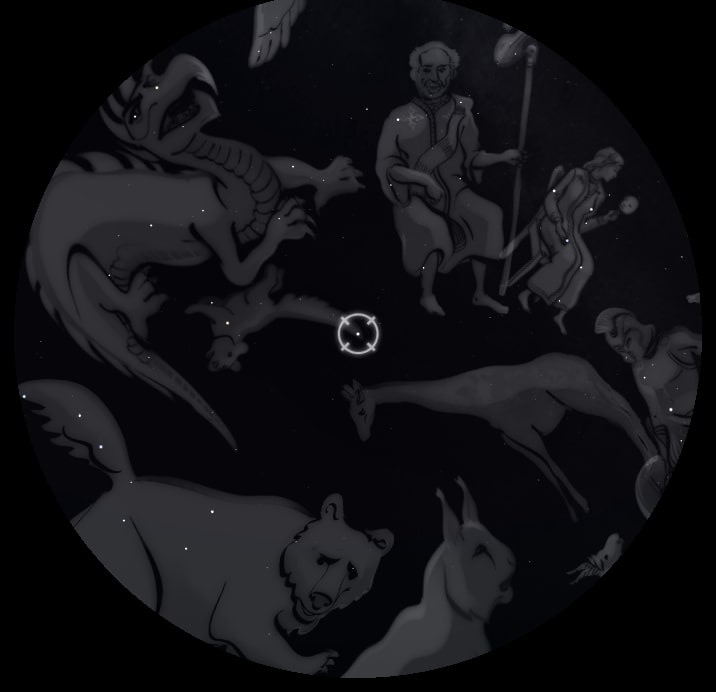
Alpha Ursae Minoris · HIP 11767 · Magnitude 1.97 · α 2.53h · δ +89.3°
from the 12th century · present polarissima
Astronomical facts (precession, Bayer letters, magnitudes) are stated separately from the atlas’s authorial biblical reading. Theological conclusions follow the published methodology.
Astronomical basis
Polaris is α Ursae Minoris, HIP 11767, apparent magnitude about 1.97. Today it lies less than one degree from the north celestial pole and will reach its closest approach around the year 2100.
From AD 1 to 1100 there was no bright, exact pole star — an astronomical fact of precession. Kochab and the future Polaris stood almost equally as two guardians near the pole. The pole then moved toward Alpha Ursae Minoris, and from the twelfth century Polaris has shone clearly as the northern guide.
Latin Polaris means ‘polar’. The Arabic name al-jady, ‘kid’, belongs to historical etymology, kept distinct from the atlas’s theological layer.
Atlas interpretation
The coming of Christ is the turning of the world: one may say ‘before the Common Era’ or ‘before the Nativity’. Christ came down from heaven to pay the price and to form His people on earth — the Church. John the Baptist said that He alone came down from heaven.
In the age without a single polarissima (the 1st–11th centuries) the atlas sees two guardians of the Little Flock: Kochab — the Torah — and Alpha — Christ. The Church was fiercely attacked: formal religion, emperors, inquisition, salvation sold for money. By 1100, the start of the twelfth century, the falling-away had reached its height. Then, in deep darkness, Polaris shone clearly: Christ as the world’s guiding star, come through Israel for all nations.
‘You do well to pay attention to it, as to a lamp shining in a dark place, until the day dawns and the morning star rises in your hearts.’ Beta led to Alpha. The Law was a guardian; after faith came, the guide is Christ, Alpha and Omega, risen from the Little Flock.
Polaris and Alkaid: from the Little Kid to the Leader
When the seven-star structure of the Little Dipper is set beside the Big Dipper, Polaris and Alkaid occupy the same terminal position at the end of their handles.
Polaris
al-Judayy · the little kidHistorical and astronomical layerThe historical Arabic name evokes a young goat. Polaris appears nearly fixed because it lies close to the north celestial pole; the whole northern sky seems to turn around it.
Alkaid · Benetnasch
al-Qāʾid Banāt Naʿsh · leader of the daughters of the bierHistorical and astronomical layerAlkaid stands at the matching tip of the Great Dipper. It is not part of the five-star core of the Ursa Major moving group and follows a different motion across the sky.
One Christ, revealed in two movements
In the atlas, Polaris speaks of Christ in sacrificial humility — the Lamb and the fixed covenantal centre. Alkaid speaks of the same Christ as the risen Head and Leader of the Great Flock. The movement is not from Israel to another root, but from sacrifice to headship and from promise to a people gathered from Israel and the nations.
See the complete comparison of the two dippers →Scripture
«I see him, but not now; I behold him, but not near. A star shall come out of Jacob, and a sceptre shall rise out of Israel.»
«For it is evident that our Lord sprang from Judah.»
«And we have the prophetic word more fully confirmed, to which you do well to pay attention as to a lamp shining in a dark place, until the day dawns and the morning star rises in your hearts.»
«So the law was our guardian until Christ came, that we might be justified by faith. But now that faith has come, we are no longer under a guardian.»
Questions
What does the Pole Star mean?
The Pole Star is Alpha Ursae Minoris, the present northern polarissima: the point around which the sky seems to turn. Sailors and travellers found north by it. In the atlas it is not only an astronomical marker but an image of Christ — the star of Jacob, risen from Israel for the whole world.
What is the polarissima of the world?
A polarissima is the star nearest the celestial pole in a given age. Today that is Polaris; around 3000 BC it was Thuban; in the biblical age of the Law Kochab was a major marker. The change is precession, not a new star appearing. The atlas sets this path beside the history of salvation: the Law leads to Christ, and Alpha rises in a dark time.
Why is Polaris the star of Jacob and Christ?
This is an authorial reading. ‘A star shall come out of Jacob’ (Numbers 24:17); ‘our Lord sprang from Judah’ (Hebrews 7:14). Polaris is Alpha of the Little Flock (Israel) and the present guide of the nations. It became a clear polarissima in the dark centuries when the Church most needed a lamp.