Kochab — the star of the Torah
Star of the Torah
So that people might see sin and be reconciled to God, through Abraham’s descendants God gives the Law — the Torah. The commandments become a guiding star for the world. From about 1500 BC to AD 1 the northern marker is Kochab, Beta of Ursa Minor.
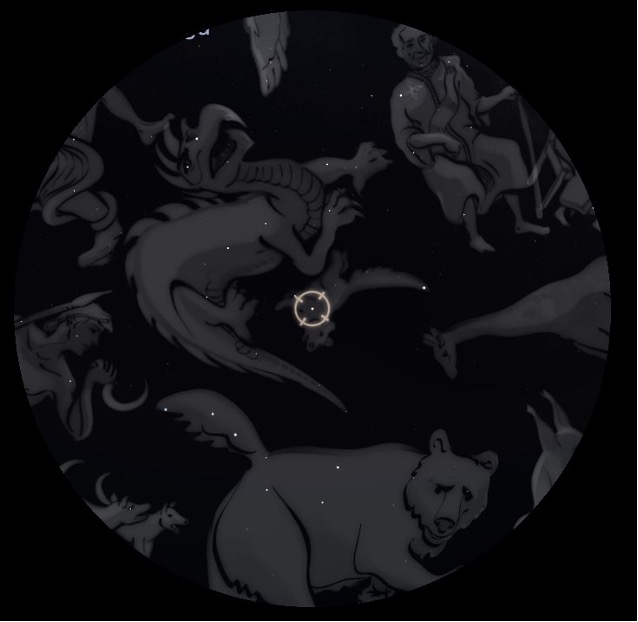
Beta Ursae Minoris · HIP 72607 · Magnitude 2.07 · α 14.85h · δ +74.2°
c. 1500 BC – AD 1
Astronomical facts (precession, Bayer letters, magnitudes) are stated separately from the atlas’s authorial biblical reading. Theological conclusions follow the published methodology.
Astronomical basis
Kochab is β Ursae Minoris, HIP 72607, apparent magnitude about 2.07. Together with Pherkad it forms the ‘Guardians of the Pole’, the bright pair at the bowl of the Little Dipper.
Axial precession makes the north celestial pole trace a circle in about 26,000 years. In late antiquity there was no single bright, exact pole star: Kochab was a major northern guide and at the start of the Common Era still lay slightly closer to the pole than Polaris.
The name Kochab probably comes from Arabic kaukab, ‘star’. That is the etymology of the proper name, not a theological meaning.
Atlas interpretation
In the atlas Ursa Minor is the Little Flock, an image of Israel. Kochab is Beta, the second star of that flock: the Law shone from Israel through Moses. The Septuagint dates Moses to 1497–1377 BC, the same era in which Kochab serves as a world marker.
Moses said that God would raise up another Prophet from among Israel’s brothers (Acts 3:22–23). If the Torah is Beta of the Little Flock, the One who rises will be first magnitude: Alpha of the same flock. Beta leads to Alpha. The Law was a guardian until Christ (Galatians 3:22–25).
The Law was given before the coming of God’s Seed, so that people might stand against the enemy of souls. It exposes sin and points toward reconciliation with God — but it does not replace the One to whom it leads.
The Guardians become the Pointers
Kochab and Pherkad in the Little Dipper and Merak and Dubhe in the Big Dipper form two different but complementary pairs around Polaris.
Kochab + Pherkad
al-Farqadān · the two calvesHistorical and astronomical layerAround 1100 BC Kochab came within about 7° of the north celestial pole. With Pherkad it served as a conspicuous northern guide; the pair is commonly called the Guardians of the Pole, although neither star marked the pole as closely as Polaris does today.
Merak + Dubhe
the Pointer StarsHistorical and astronomical layerA line from Merak through Dubhe leads directly toward Polaris. Merak derives from the Arabic word for the loins or flank; Dubhe from the Arabic word for bear.
From guarding the direction to proclaiming it
The atlas reads the Little Flock as Israel receiving and guarding the direction through Torah, covenant and sacrificial worship. The Great Flock does not replace that direction: the Church becomes a witness, pointing the nations to the same Messiah. This is a functional correspondence between two pairs, not a claim that Kochab is geometrically paired with Merak.
See the complete comparison of the two dippers →Scripture
«Moses said to the fathers, ‘The Lord your God will raise up for you a Prophet like me from among your brothers; you shall listen to Him in all that He tells you. And it shall be that every soul who does not listen to that Prophet shall be destroyed from the people.’»
«Scripture imprisoned everything under sin, so that the promise by faith in Jesus Christ might be given to those who believe. Before faith came, we were held under the law… So the law was our guardian until Christ, that we might be justified by faith.»
«So the law was our guardian until Christ came, that we might be justified by faith.»
Questions
What does ‘pole star’ mean?
In ordinary speech the pole star is the bright northern guide around which the sky seems to turn. Astronomically it is the polarissima: the star nearest the pole in a given age. Precession changes that star: once it was Thuban, then Kochab was a major marker, and today it is Alpha Ursae Minoris.
What is the polarissima of the world?
A polarissima is the star closest to the north (or south) celestial pole. It is not a permanent title of one star, but a position on the precession circle. At the beginning of the Common Era there was no bright exact polarissima: Kochab and the future Polaris stood at nearly equal distances. The atlas reads this as the age of two guardians — the Law and Christ.
Why is Kochab the star of the Torah?
This is the atlas’s authorial reading, not an official astronomical name. Kochab is Beta of the Little Flock (Israel) and a northern guide from roughly the age of Moses until the birth of Christ. The Law shone from Israel and led the world until Alpha — Christ — came.