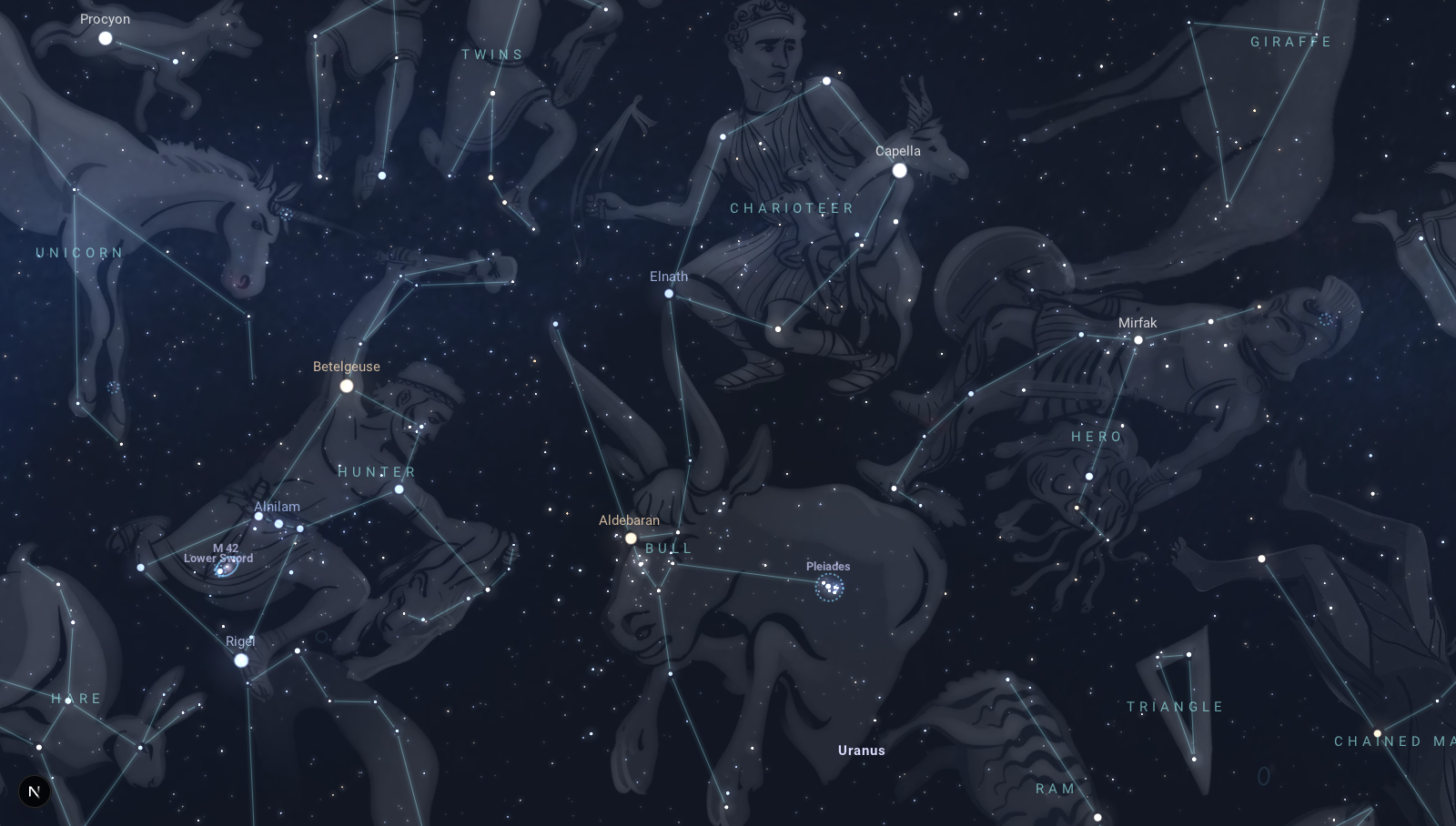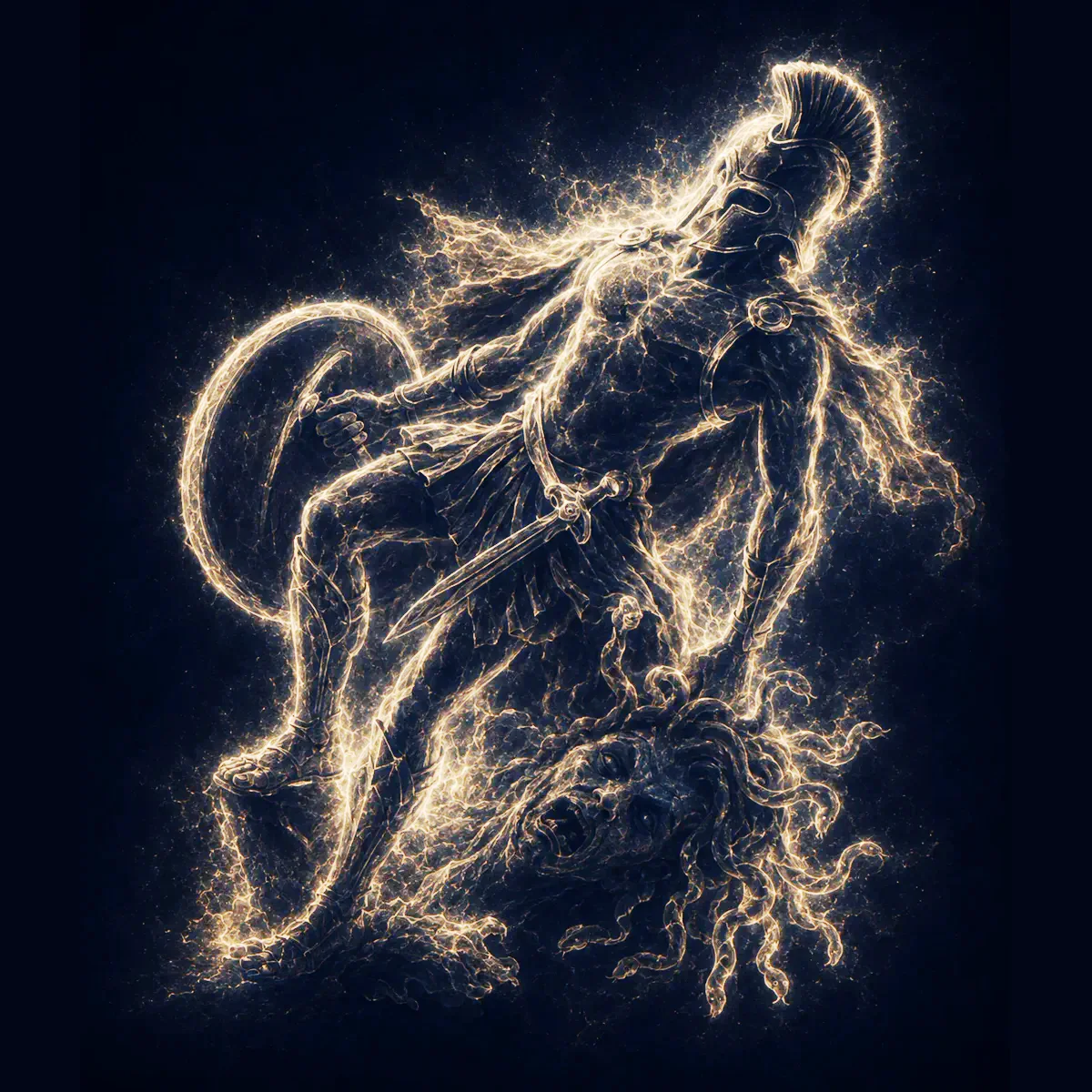
Perseus symbolizes Satan and the fallen angels of the first wave, who rebelled against God before the Watchers. On the star chart, Perseus and Orion-Kesil surround Taurus from two sides: Perseus approaches it from behind, Orion attacks from the front. These are two waves of angelic rebellion against God's order. The nature of Perseus is especially clearly revealed by the star Algol — its ancient Arabic name Ra's al-Ghūl means 'Head of the Demon'. Perseus also lies between the Pleiades — the Church-Bride — and Cassiopeia — the Church already enthroned as the Wife of the Lamb: Satan opposes God's people and strives to prevent them from reaching the glory intended for them.
Full interpretation
Verifiable historical, etymological and topographical statements are accompanied by sources. The theological conclusions are the project’s interpretation according to its published methodology.
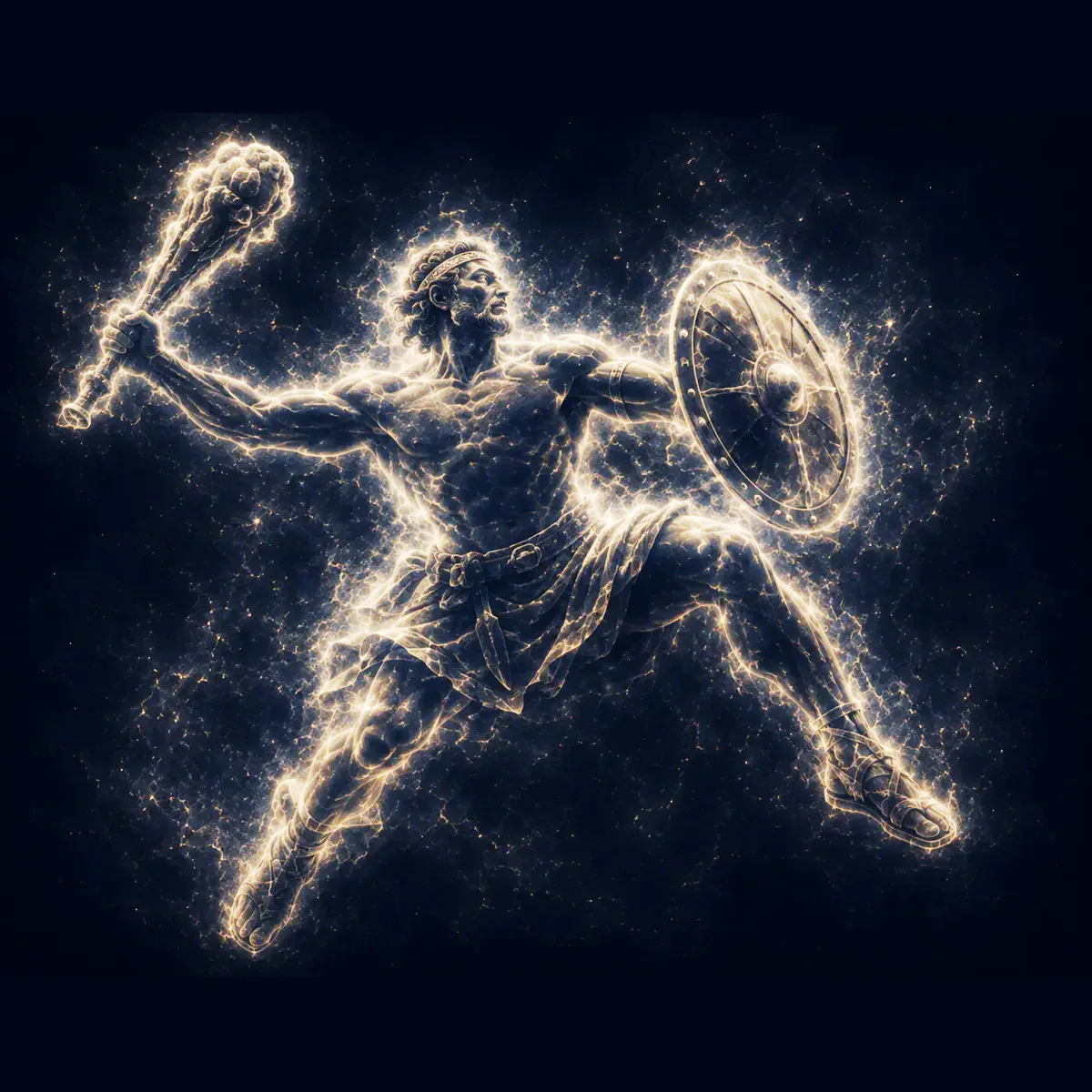
Perseus represents the first angelic rebellion — Satan and the angels who followed him. This rebellion occurred before the fall of the Watchers depicted by Orion-Kesil. Therefore the two constellations on opposite sides of Taurus show two different waves of the same opposition to God.[Kunitzsch & Smart][IAU · имена звёзд]
Their position differs not by chance. Orion-Kesil stands before Taurus and throws an open challenge at it. Perseus is on the other side, behind Taurus. The Watchers of the second wave went into a conscious open rebellion after the first fall and, knowing its consequences, left their appointed place. Satan, however, acts as the ancient adversary, seducer, and accuser — the one who strikes subtly, deceives, and seeks to destroy God's plan.[Kunitzsch & Smart][IAU · имена звёзд]
The most ancient Mesopotamian image of this region of the sky was called ŠU.GI — 'Old Man'. Its territory corresponded to modern Perseus and in some reconstructions extended farther to the northern stars of Taurus. Thus the ancient figure itself literally intruded into the region of Taurus. This fits well with the heavenly picture of opposition.[Hunger & Pingree · MUL.APIN][Rogers · Origins][Вавилонские звёздные каталоги][Stellarium · MUL.APIN][Kunitzsch & Smart][IAU · имена звёзд]
The most expressive star of Perseus is Algol. Its Arabic name Ra's al-Ghūl means 'Head of the Demon'. In the medieval Jewish tradition, this name was rendered as Rosh ha-Shed — 'head of the demon'. Therefore in the constellation itself lies one of the most explicitly named demonic stars in the entire sky.[Kunitzsch & Smart][IAU · имена звёзд]
Algol also periodically and sharply loses brightness and then becomes bright again. In the sky, this star literally looks like a light that regularly plunges into darkness. This remarkably corresponds to the image of a fallen spiritual being: created as a heavenly luminary, but having lost its original position through rebellion.[Kunitzsch & Smart][IAU · имена звёзд]
The position of Perseus relative to God's people is also very important. The Pleiades are in Taurus and represent the Church-Bride; above, beyond Perseus, lies Cassiopeia — the enthroned Church, the Wife of the Lamb. Between the state of the Bride on earth and her future glory stands the adversary. This is exactly what Satan does in Scripture: he wages war against the saints, accuses them before God, persecutes the Woman, and tries to hinder the fulfillment of God's plan.[Kunitzsch & Smart][IAU · имена звёзд]
Thus the heavenly scene shows the sequence of angelic rebellion:
Perseus — the first wave: Satan and his angels. Orion-Kesil — the second wave: the Watchers, bound by God. Taurus — God's order, against which they rebel.
Moreover, Taurus is attacked from two sides: Satan from behind, the Watchers from the front. But the entire subsequent heavenly history shows that neither the first nor the second wave of rebellion will be able to destroy God's plan.