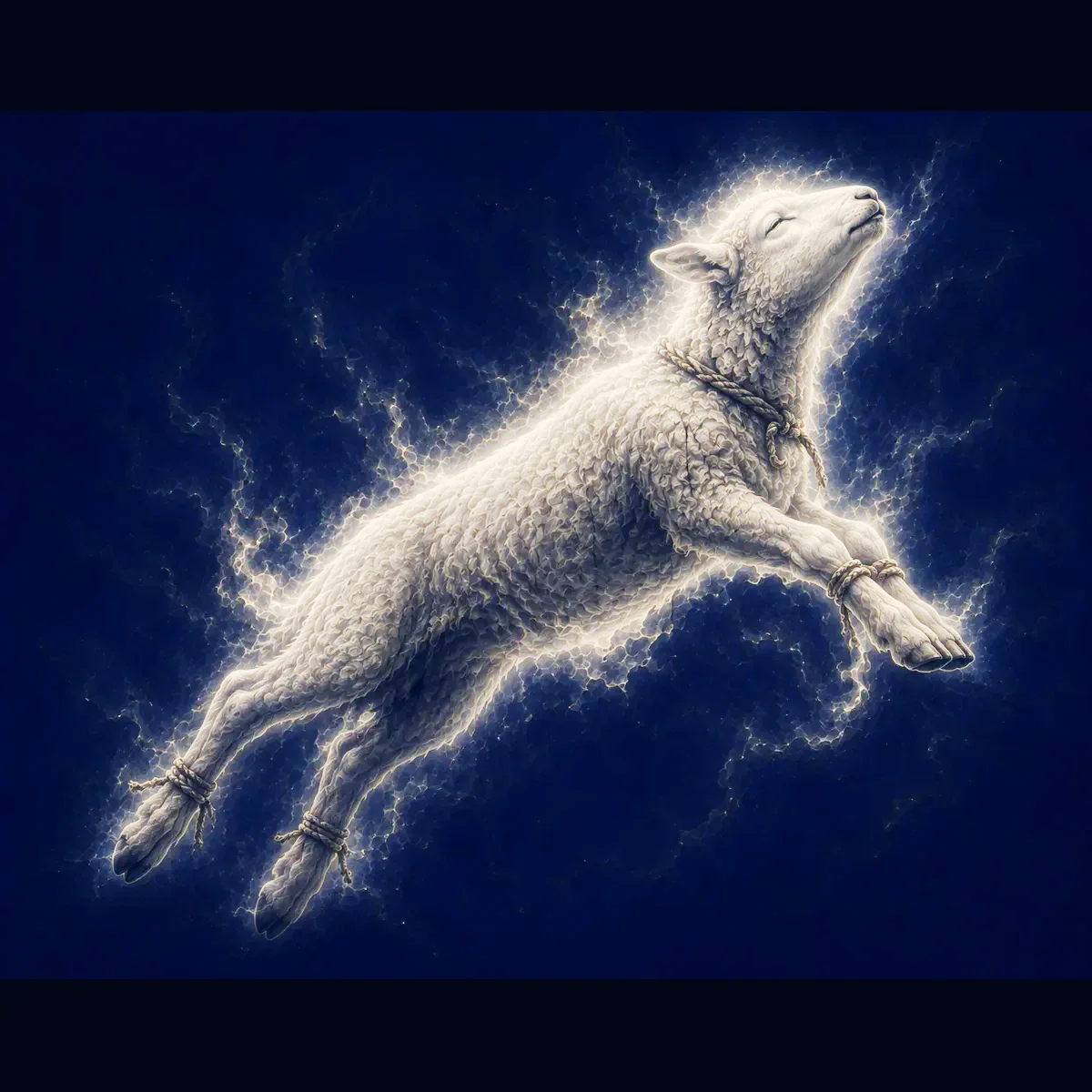
The constellation of the Wolf depicts the sacrifice offered for redemption. The modern name 'Wolf' is secondary: the ancient Greeks called this figure simply Therion — 'Beast', and on ancient depictions it is already pierced and in the hands of Centaurus, who carries it toward the neighboring constellation of the Altar — Ara. Ancient authors directly described the animal as a victim. Therefore the main meaning lies not in the wolf itself, but in the position of the figure: Victim → Altar. In the biblical picture, this points to Christ, who voluntarily offered Himself to God as the perfect atoning sacrifice for the sins of the world.
Full interpretation
Verifiable historical, etymological and topographical statements are accompanied by sources. The theological conclusions are the project’s interpretation according to its published methodology.
Today this constellation is called Lupus — Wolf, but such an identification of the animal became fixed relatively late. For the ancient Greeks, it was simply Θηρίον — Therion, 'Beast', and the Romans called it Bestia — 'animal, beast'. The most important thing was not what kind of animal it was, but what was happening to it.[Kunitzsch & Smart][IAU · имена звёзд]
The Beast is depicted next to Centaurus. Centaurus holds it, pierced on a long shaft, and extends it in the direction of the neighboring Altar — Ara. Eratosthenes described this scene as an animal being carried to the altar for sacrifice; Hyginus directly called it a victim. On ancient celestial globes and in subsequent atlases, these three figures — Centaurus, Lupus, and Ara — form one composition of sacrifice.[Kunitzsch & Smart][IAU · имена звёзд]
Therefore the biblical meaning of the constellation is revealed almost directly:[Kunitzsch & Smart][IAU · имена звёзд]
there is a Victim; there is an Altar; the Victim is already pierced; it is being brought to the Altar.[Kunitzsch & Smart][IAU · имена звёзд]
This is an image of the atoning death of Christ.
Jesus came not merely to teach people. The central purpose of His earthly journey was to offer Himself as a sacrifice for sin.
The Epistle to the Hebrews says:
'He... has appeared once for all at the end of the ages to put away sin by the sacrifice of Himself.'[Kunitzsch & Smart][IAU · имена звёзд]
And again:
'Christ... offered Himself without blemish to God.'
That is why it is especially important here that the victim is not depicted as an animal that died accidentally. The whole composition is directed toward the Altar. This is a sacrifice being offered.[Kunitzsch & Smart][IAU · имена звёзд]
Christ spoke of His death in the same language of voluntariness:
'I lay down My life... No one takes it from Me, but I lay it down of My own accord.'
Therefore the constellation shows not Christ's defeat by the enemy, but His voluntary offering of Himself for the salvation of others.[Kunitzsch & Smart][IAU · имена звёзд]
Not Wolf, but Victim
The most ancient Mesopotamian layer of this region differed from the Greek picture. In the area of modern Lupus was the constellation UR.IDIM — 'Mad/wild dog'. In memory of this Babylonian tradition, the International Astronomical Union officially gave the brightest star α Lupi the name Uridim in 2024.[Hunger & Pingree · MUL.APIN][Rogers · Origins][Вавилонские звёздные каталоги][Stellarium · MUL.APIN][Kunitzsch & Smart][IAU · имена звёзд]
But in the transition to the Greco-Roman celestial tradition, the emphasis changed: the animal became a sacrificial beast that Centaurus carries to the altar. This geometric image is especially important for our map.[Kunitzsch & Smart][IAU · имена звёзд]
Therefore the word 'Wolf' should not determine the biblical meaning of the constellation.
The main point here is:
not what kind of beast it is, but that it is offered as a sacrifice.
Star names
The old name Kakkab, sometimes attributed to α Lupi, also does not mean 'Guiding'. Kakkabu is the ordinary Akkadian word for 'star', and the full form Kakkab Su-gub Gud-Elim cited by R. H. Allen was rendered as 'star to the left of the Horned Bull', linking this region to the figure of Centaurus.[Hunger & Pingree · MUL.APIN][Rogers · Origins][Вавилонские звёздные каталоги][Stellarium · MUL.APIN][Kunitzsch & Smart][IAU · имена звёзд]
The names Thusia for γ Lupi and Hilasmus for δ Lupi occur in later literature, but they are not reliably attested ancient proper names of these stars. Modern historical research on Lupus directly notes that its stars have no preserved classical proper names; the ancient name Uridim was officially restored for α Lupi only recently.[Kunitzsch & Smart][IAU · имена звёзд]
But the Greek words themselves remarkably fit the biblical theme.
θυσία — thusia means 'sacrifice'.
ἱλασμός — hilasmos means 'propitiation, atonement', and it is precisely this word John uses of Christ:
'He is the propitiation for our sins.'
Therefore these words can be used to explain the theological meaning, but they should not be presented as ancient names of specific stars.
Sacrifice offered for others
In the overall star history, the Wolf reveals the most important side of salvation.[Kunitzsch & Smart][IAU · имена звёзд]
Sin requires atonement.
Man is unable to atone for himself.
Therefore God Himself provides the Victim.
John the Baptist, seeing Christ, says:
'Behold, the Lamb of God, who takes away the sin of the world.'
Here two celestial images meet.
Aries shows who the Victim is — the Lamb of God.
The Wolf shows the very fact of offering the sacrifice — a pierced animal is carried to the Altar.[Kunitzsch & Smart][IAU · имена звёзд]
And the constellation Ara shows the Altar on which this sacrifice is to be made.[Kunitzsch & Smart][IAU · имена звёзд]
Thus the sequence is:
Lamb → Victim → Altar.[Kunitzsch & Smart][IAU · имена звёзд]
And all this is fulfilled in Christ.[Kunitzsch & Smart][IAU · имена звёзд]
He is simultaneously the One who offers the sacrifice and the Sacrifice itself:
'Christ... through the eternal Spirit offered Himself without blemish to God.'
The main meaning
The constellation of the Wolf actually speaks not of a wolf.[Kunitzsch & Smart][IAU · имена звёзд]
It speaks of the Victim.
The ancient figure shows an already stricken animal being carried to the heavenly Altar. Therefore in the biblical map, this is one of the most direct images of Christ's atoning death.[Kunitzsch & Smart][IAU · имена звёзд]
He was pierced. He voluntarily gave Himself. He was offered to God. His sacrifice was made for the sins of others.
Therefore the true meaning of this heavenly picture is:
Christ — the Atoning Sacrifice.