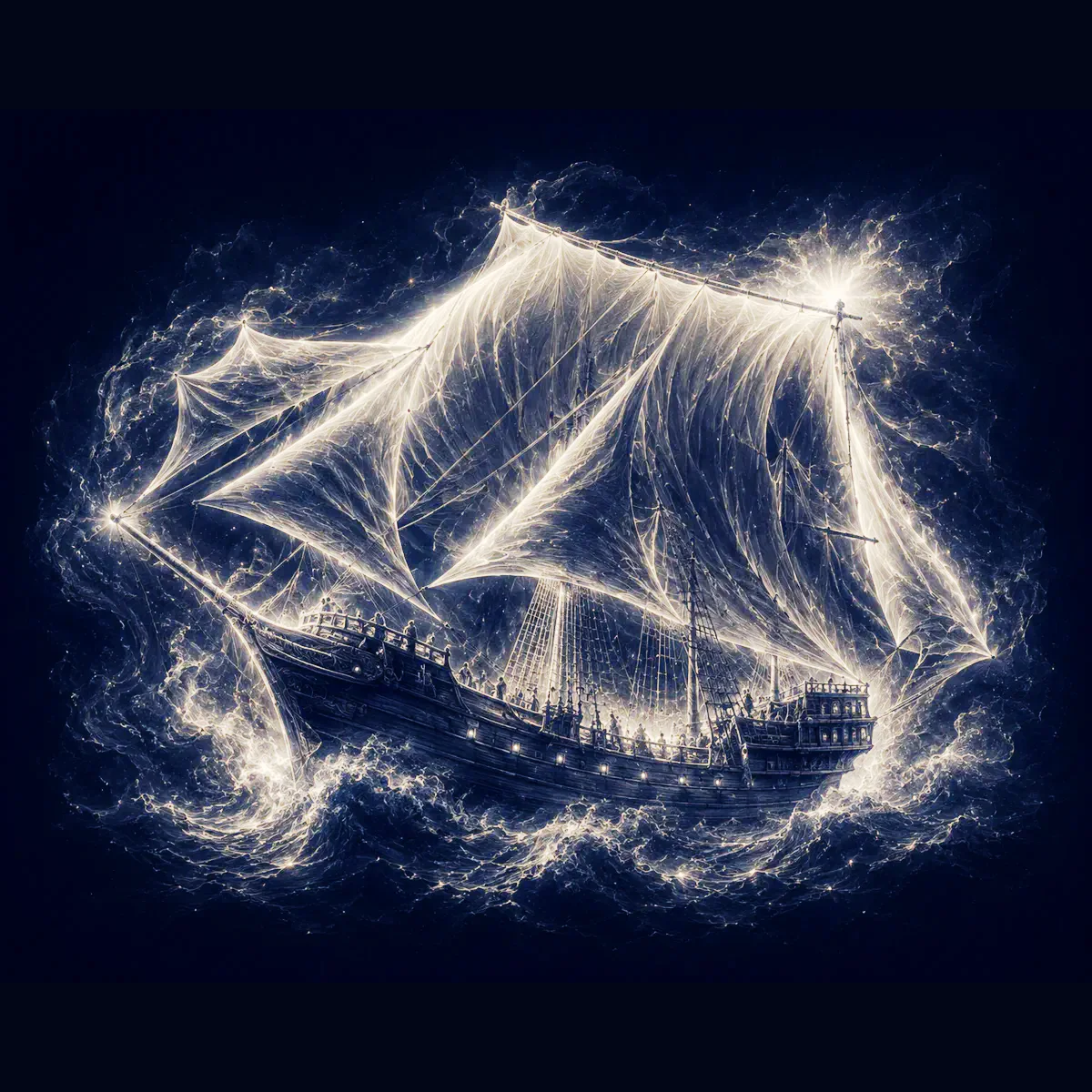
The Sails are part of the ancient great Ship, which today is divided into Keel, Stern, and Sails. In the biblical picture, this Ship represents the redeemed people of God safely returning home, and the Sails reveal how it moves: not by its own strength, but receiving the wind — a beautiful image of a people led by the Spirit of God. In the overall picture of Cancer, after the two flocks of God — Israel and the Church — the Ship appears, carrying those gathered by God to a place of rest. The ancient description is especially expressive: the Ship goes stern-first, as if already entering the harbor after a completed voyage.
Full interpretation
Verifiable historical, etymological and topographical statements are accompanied by sources. The theological conclusions are the project’s interpretation according to its published methodology.
The modern Sails (Vela), Keel (Carina), and Stern (Puppis) were not originally separate constellations. They constituted one huge ancient constellation — the Ship, Argo Navis. The Sails were separated as an independent part only in the 18th century, so their meaning must be considered within the whole Ship.[Kunitzsch & Smart][IAU · имена звёзд]
In the heavenly sequence of Cancer, this Ship completes the picture of the gathering of God's people. Ursa Minor shows one flock of God, Ursa Major another, and then follows the Ship: those gathered by God are no longer scattered — they are returning home. That is why the ancient image of the Ship is especially fitting for the final salvation and gathering of the redeemed. Bullinger defined this picture as 'the redeemed pilgrims safely home'.[Kunitzsch & Smart][IAU · имена звёзд]
The very posture of the heavenly Ship is remarkable. Already Aratus described Argo as a vessel moving stern-first, like a ship that, having finished its voyage, turns around and enters the harbor. This is not an image of a ship just setting out into the unknown, but of a completed journey and a return to the shore.[Kunitzsch & Smart][IAU · имена звёзд]
It is here that the part of the Ship called the Sails becomes especially significant. The sail does not create motive power by itself — it is spread to the wind and allows the wind to guide the ship. The biblical words רוּחַ — ruach and πνεῦμα — pneuma combine the concepts of spirit, breath, and wind. Therefore the Sails become an image of God's children, who do not chart their course by their own strength alone, but are led by the Spirit of God.[Kunitzsch & Smart][IAU · имена звёзд]
This nautical nature is preserved in the ancient star names. Alsephina (δ Velorum) comes from the Arabic al-safīnah — 'ship'; originally it was the Arabic name for the whole Argo Navis. Markeb (κ Velorum) comes from the Arabic markab — 'vessel, vehicle, something on which one rides'. Thus, even after the division of the ancient Ship, the star names of the Sails continue to testify to the original unified image of the vessel.[Kunitzsch & Smart][IAU · имена звёзд]
The sky map reinforces this thought. The Sails are directly connected to the Keel and Stern and cannot be understood apart from them. The whole ancient Ship lies on the bright band of the Milky Way and stretches between the region of Canis Major and Centaurus; the long Hydra passes above it. Thus, before us is not a small separate sign, but a vast heavenly image of a people on the way, whom God preserves and leads to the appointed haven.[Kunitzsch & Smart][IAU · имена звёзд]
In this, the sequence of images in Cancer is especially well revealed: God gathers His people into a flock, preserves those who belong to Him, places them in His Ship, and Himself leads them home. The Sails show the principle of this path — God's people reach the goal not by their own strength, but because they are directed by God's Spirit.[Kunitzsch & Smart][IAU · имена звёзд]