What Could Betelgeuse’s Explosion Mean?
Kesil, the Bound Angels, and the Sixth Trumpet
What would happen if Betelgeuse exploded? Could a supernova in Orion carry meaning as a biblical sign—and why does the closest parallel lead not to Wormwood, but to the release of the bound angels at the Euphrates?
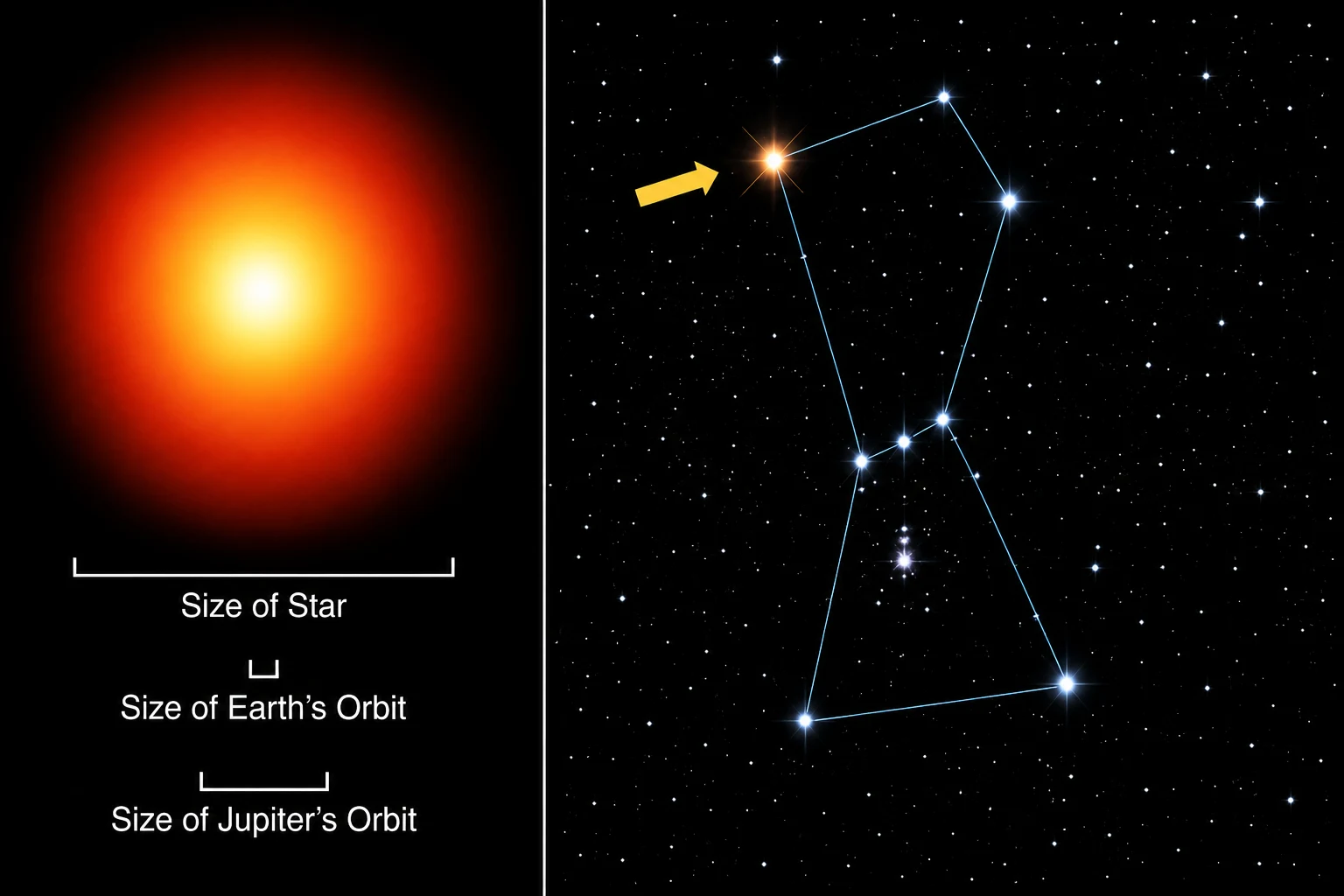
A red supergiant in the shoulder of Orion
The first panel compares the scale of Betelgeuse with planetary orbits. The atlas panel is generated from the project’s J2000 star coordinates and constellation segments; Betelgeuse (HIP 27989) is marked in red.
The sky as a sign
Betelgeuse is a red supergiant in Orion, roughly 650 light-years from Earth. It will one day end as a supernova, but astronomers do not have a reliable countdown. An estimate on the order of 100,000 years belongs to one family of evolutionary models, while an alternative 2023 study placed the star in a much later carbon-burning stage and allowed a timescale of less than a few centuries. Because of the distance, we see the star as it was about six and a half centuries ago.
The Bible presents the lights of heaven as more than physical objects. Genesis appoints them ‘for signs’; Psalm 19 says the heavens declare and night reveals knowledge; Christ warns of signs in the sun, moon, and stars. This raises a natural question: if a principal star in an ancient biblical constellation suddenly became a supernova, what might that sign communicate?
«Let them be for signs…»
Betelgeuse is not merely in Orion. It is in Kesil
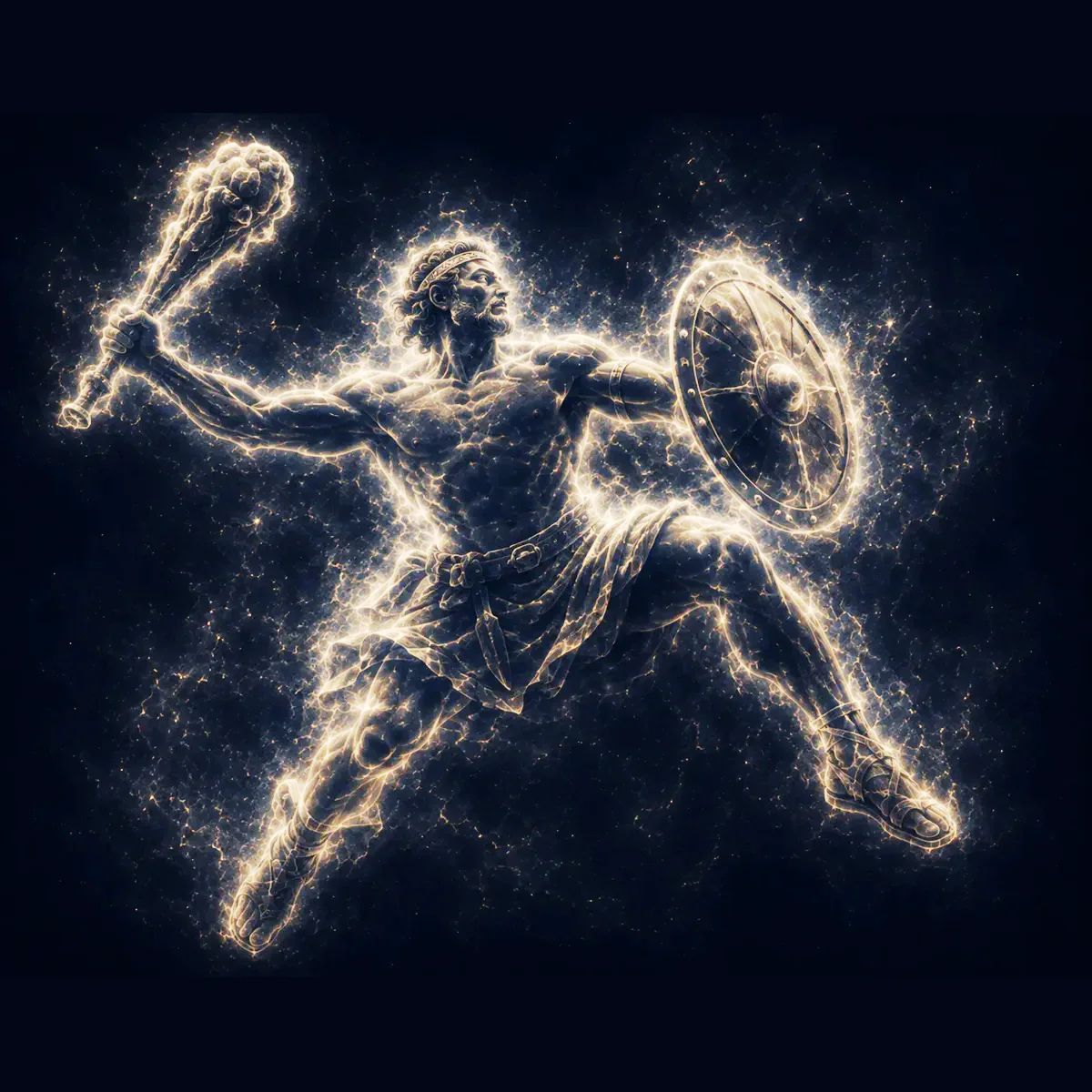
Modern readers know the figure by its Greek name, Orion. The Hebrew Bible uses כְּסִיל—Kesil—in Job 9:9, Job 38:31, Amos 5:8, and Isaiah 13:10. Biblical lexicons traditionally identify Kesil with Orion, and the ancient image has sometimes been described as a giant bound in the sky.
‘Can you loose the bonds of Kesil?’
In Job 38 God lists mysteries of creation beyond human command. The phrase מֹשְׁכוֹת כְּסִיל—moshekhot Kesil—denotes Kesil’s cords, bands, or bonds. The nearby verb, pataḥ, carries the action of opening, untying, or releasing.
Many modern translations therefore render the question directly: ‘Can you loosen Orion’s belt?’ or ‘loose the cords of Orion?’ The language of binding belongs to the Hebrew text itself; it is not supplied by modern eschatology.
«Can you bind the cluster of the Pleiades, or loose the belt of Orion?»
Angels bound until the appointed time
Jude writes that angels who abandoned their proper station are kept ‘in everlasting chains under darkness for the judgment of the great day.’ Second Peter uses a similar image. A stable biblical pattern emerges: supernatural beings are bound by God until a predetermined moment of judgment.
The same structure appears at the sixth trumpet. John hears a command to release four angels bound at the great river Euphrates. The Greek words Λῦσον and δεδεμένους stress the movement: loose those who remain bound. They have been prepared for an hour, a day, a month, and a year, and they emerge only at the command.
«Release the four angels who are bound at the great river Euphrates.»
- Job 38: Kesil—bonds—to loose.
- Jude and 2 Peter: angels—bonds—waiting for judgment.
- Revelation 9: angels—appointed time—release.
Why Betelgeuse is especially interesting
Betelgeuse occupies a central place in Orion-Kesil and marks the figure’s shoulder. Its name ultimately comes from Arabic yad al-jawzāʾ, ‘the hand of al-Jawza.’ The image is striking: Kesil is bound, while a huge red star destined one day to explode stands at his hand or shoulder.
Ancient Kesil appears as a shackled mighty being, so a radical change at its ‘hand’ becomes a powerful symbol linking the heavenly image with Scripture’s language of release.
Why it looks less like Wormwood
Betelgeuse is sometimes linked automatically with Wormwood in Revelation 8. Yet Wormwood falls from heaven and strikes rivers and springs. A Betelgeuse supernova would look quite different: a familiar point in Orion would become extraordinarily bright, but it would not travel across the sky toward Earth.
The sequence ‘Kesil → bonds → loosening → bound angels → release’ therefore fits the image more closely than the Wormwood parallel.
The sign of bound powers being released
A Betelgeuse supernova will serve as a heavenly sign of the transition from restraint to the release of bound powers before judgment. The supernova itself does not release angels: the command comes from God, while the heavenly event signifies what is happening in the unseen realm.
The sky is a book of images, and Kesil is one chapter in that book. When one of its principal stars changes before all humanity, the ancient image of bonds and release will unfold before the world.
Kesil is bound until God loosens his bonds
In Job, God does not merely say that He made Orion. He asks whether a human can loose Kesil’s bonds. The answer is plain: humanity cannot, but God can. He made Kesil, set its limits, knows its bonds, and possesses authority to release them.
The bound beings in Revelation likewise do not free themselves. They remain restrained until a command comes from the divine presence. The connection between Job 38 and Revelation 9 therefore deserves close attention.
Why the Euphrates?
The Euphrates first appears in Eden, later marks a boundary of the land promised to Abraham, and lies toward the eastern empires through which judgment came upon Israel.
In Revelation the river appears twice in the setting of final events: bound angels are released there at the sixth trumpet, while at the sixth bowl its water dries and prepares the way for kings from the east. The Euphrates thus becomes one of the key earthly locations in Revelation’s eschatological landscape.
Heavenly and earthly topography
In the biblical imagination, earthly events and heavenly signs can form one picture. On earth stands the Euphrates; in the spiritual realm are bound angels; in the sky stands Kesil, described by Scripture in the language of bonds.
- Earthly location: the Euphrates.
- Spiritual event: release of the bound angels.
- Heavenly image: the loosening of Kesil’s bonds.
- Heavenly sign: a radical change in Betelgeuse.
The moment the sign appears matters
If observers see a supernova, the physical event itself occurred roughly seven centuries earlier. Yet it becomes a sign for humanity when its light reaches Earth. Cosmic distance does not undermine the reading; it shows how far in advance a visible event may have been prepared for an appointed moment.
What, then, could the supernova mean?
The supernova points to the end of restraint, the arrival of an appointed time, the release of formerly bound powers, and the approach of judgment. One vocabulary runs through the texts: bind—restrain—loose—release.
Such an event will be more than an extraordinary astronomical sight: it will become a resounding heavenly answer to the question, ‘What is the sky saying?’
What does modern astronomy say?
Betelgeuse will indeed end as a supernova, but its surface does not reveal an exact date. Widely used models in which the star is still burning helium in its core give a timescale on the order of 100,000 years. A 2023 study by Saio and colleagues interpreted the 2,200-day cycle as the fundamental pulsation, placed Betelgeuse near the end of core carbon burning, and obtained less than about 300 years to carbon exhaustion followed by a few tens of years to collapse.
Research from 2024–2026 instead connected the 2,100–2,200-day cycle to the close companion Siwarha and identified the roughly 416-day cycle as the fundamental pulsation. That weakens the central premise of the short-timescale model and again favors an earlier evolutionary stage. The honest statement today is therefore that the supernova may be astronomically near, but neither ‘in 100,000 years’ nor ‘within decades’ is an established countdown. The Great Dimming of 2019–2020 is likewise associated with expelled material and dust, not a demonstrated warning of imminent collapse.
If Betelgeuse truly flares
Picture the familiar Orion: the same belt and outline of Kesil seen by humanity for millennia. Then its red shoulder—its ‘hand’—becomes a supernova. Alongside the astronomical question, another would arise: ‘What is the sky saying?’
The answer stands between Job’s question, ‘Can you loose the bonds of Kesil?’ and the apocalyptic command, ‘Release the four angels who are bound at the great river Euphrates.’ The two texts meet in one image: bound powers remain restrained until God’s appointed hour of release.
Frequently asked questions
When will Betelgeuse explode?
We do not know. Models range from less than a few centuries in a disputed late-carbon-burning interpretation to roughly 100,000 years in helium-burning models. Evidence for the companion Siwarha weakened the short-timescale argument, but observations provide no precise countdown.
Could Betelgeuse have exploded already?
We see it with a delay of roughly 650 years because of its distance, so its present physical state cannot be observed directly.
Is Betelgeuse the star Wormwood?
Revelation describes Wormwood as a falling star that strikes the waters. This article finds a closer parallel in the ‘bonds of Kesil’ in Job 38:31 and the bound angels of Revelation 9:14.
Where does the Bible mention Orion?
Under the Hebrew name Kesil, it appears in Job 9:9, Job 38:31, Amos 5:8, and Isaiah 13:10.
What happens at the sixth trumpet?
In Revelation 9:13–15, four angels bound at the Euphrates and prepared for a specific moment are released.